
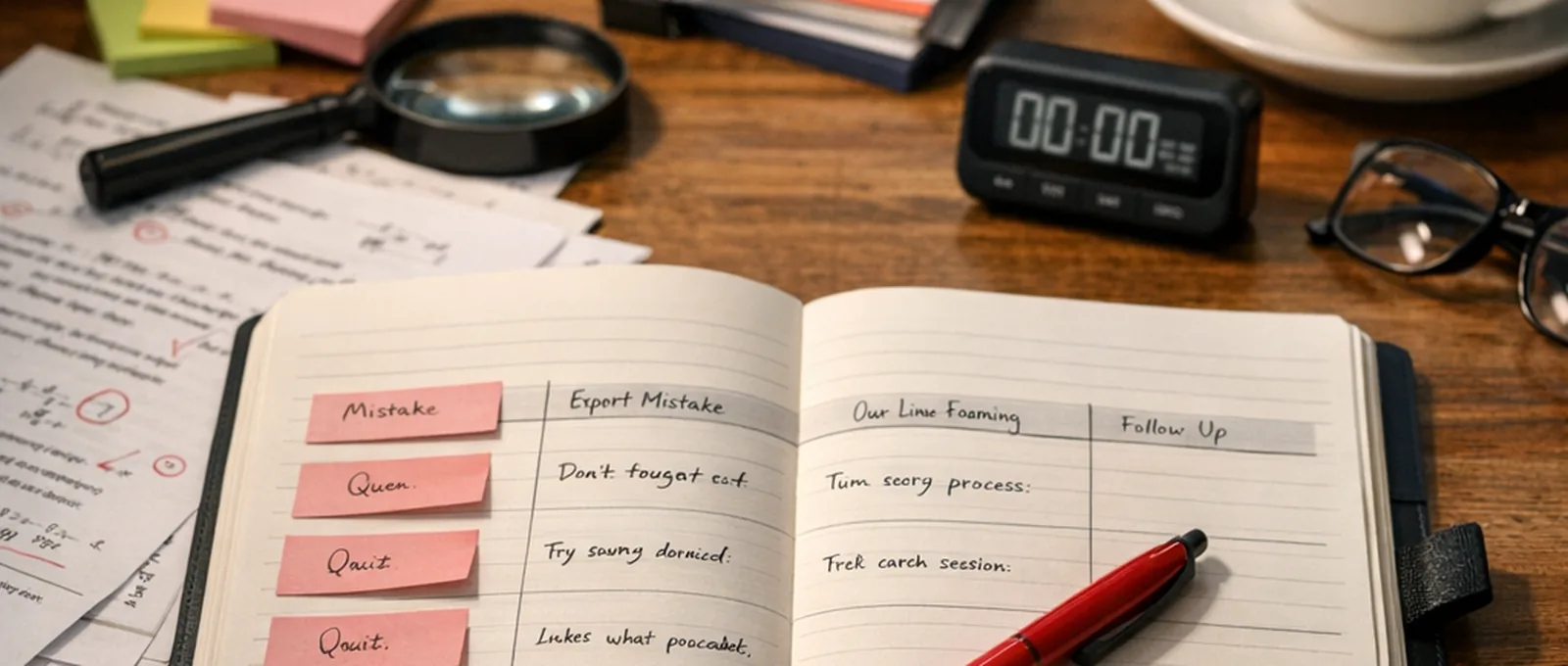
The 30-Minute Error Log System: Turn Every Wrong Answer Into a Higher Score (Without Re-Doing Everything)
Re-doing entire problem sets feels productive. It’s also how you get really good at repeating the same 7 mistakes with confidence.
An error log fixes that. Not by making you write more. By making you repeat fewer errors.
Why an error log beats “just do more questions”
Most score plateaus aren’t caused by lack of effort. They’re caused by a small set of mistake patterns that keep showing up in different outfits.
- Most plateaus come from repeating the same 5–10 mistake patterns
- Doing more questions without diagnosis = practicing your mistakes
- An error log is a feedback loop: mistake → cause → fix → quick retest
- Goal: fewer repeat mistakes, not a bigger notebook
What an error log is (and what it’s not)
- Is: a short list of recurring errors with a clear fix and a next action
- Not: rewriting full solutions or copying the textbook explanation
- Not: a guilt journal—keep it neutral and useful
Good error log vibe: “Here’s what happened, here’s why, here’s the tiny system that prevents it next time.”
Who benefits most
- Anyone doing past papers, practice tests, quizzes, homework sets
- Subjects with lots of problems: math, physics, chem, econ, stats
- Also works for essays: argument gaps, evidence issues, misread prompts
Set up your “lightweight” error log in 5 minutes
Pick a format you’ll actually open when you’re tired.
- Notes app, Google Sheet, notebook, Notion—anything works
- Rule: each entry must fit on 3–5 lines (forces clarity)
- Create 6 fields and you’re done
The only fields you need
Source: test/set name + question number
Mistake type: Concept / Process / Careless / Misread / Time
What I did: 1 sentence (no essays)
Root cause: why it happened (the real reason)
One-line fix: the rule/check that would have prevented it
Next drill: smallest follow-up task + date
A copy-paste template (one entry)
Q: ___ | Topic: ___ | Type: ___
What happened: ___
Root cause: ___
One-line fix: ___
Next drill (10 min max): ___ on (date) ___
The 30-minute workflow (use it after any practice set)
This is not a second study session. It’s the conversion step where wrong answers become future points.
- Time-box it: quick conversion, not perfection
- Do it while the problem is still fresh (same day if possible)
- Aim for patterns and fixes, not a complete autobiography of your math trauma
Minute 0–5: Triage your results
- Star every wrong or “lucky” correct (guessed, shaky reasoning)
- Group by topic if possible (e.g., “integration by parts”, “redox”)
- Pick the top 3–5 mistakes to log—don’t log everything
Minute 5–20: Diagnose each mistake (fast, but honest)
- Label the type: Concept vs Process vs Careless vs Misread vs Time
- Write “What I did” in one sentence (example: “assumed linear, didn’t check”)
- Ask the killer question: “What would I do differently next time?”
- Extract the minimum rule/check that would have saved you
Minute 20–27: Create the smallest follow-up drill
Your drill should be so small it’s almost annoying.
- Concept gap → 5-minute micro-relearn + 3 targeted questions
- Process error → write a 3-step checklist and redo 1 similar question
- Careless → add a verification step (units, sign, boundary, reread)
- Misread → highlight constraint words; practice “prompt paraphrase”
- Time → choose one speed tactic (skip rule, pacing marks, setup first)
Minute 27–30: Schedule + close the loop
- Put the drill on your calendar/task list (same week)
- Add a tag like “REPEAT” if you’ve made it before
- Stop. Don’t spiral into redoing the whole set
Mistake types (and fixes that actually work)
Most students label everything “careless.” That’s like calling every illness “bad vibes.” Helpful? Not really.
- Mislabeling hides the real fix (often it’s process, not careless)
- Your fix must be executable under exam pressure
- If the fix can’t be done in ~5 seconds during a test, it’s too big
Concept gap (you didn’t know the idea)
- Signals: blanking, using the wrong formula, not knowing why steps work
- One-line fix examples: “If condition X, use Y because ___”
- Best drill: 3–5 questions of the same exact sub-skill, back-to-back
Process error (you know it, but your steps leak points)
- Signals: wrong method choice, messy algebra chain, skipping a key step
- One-line fix examples: “Always isolate variables before substituting”
- Best drill: write a micro-checklist + redo one similar question cleanly
Careless (preventable execution slip)
- Signals: sign mistakes, copying numbers wrong, forgetting a minus, units
- One-line fix examples: “Final line check: sign + units + magnitude”
- Best drill: 5 easy questions with a forced slow final-check routine
Misread (the question beat you, not the content)
- Signals: answered a different thing than asked; ignored constraints
- One-line fix examples: “Paraphrase prompt in 7 words before solving”
- Best drill: 10 prompts—paraphrase only, then compare to marking scheme
Time/pacing (you ran out, rushed, or got stuck too long)
- Signals: unfinished sections, big drop in accuracy late in the paper
- One-line fix examples: “If not progressing in 90s, mark and move”
- Best drill: 15-minute timed mini-set + reflect on where time went
Weekly review: the 15-minute session that makes the log pay off
If you never review it, your error log is just stationery with vibes.
- Weekly review turns one-off fixes into automatic habits
- Keep it short so you’ll actually do it every week
The weekly routine (15 minutes)
- Sort/filter: show entries from the last 7–14 days
- Count repeats: which mistake types show up most?
- Pick 1 theme for the week (example: “misread constraints”)
- Do 1 targeted drill immediately (5–10 minutes)
- Write one “exam rule” you’ll apply next practice test
The “repeat mistake” rule
- If the same error appears 2+ times → it needs a system, not motivation
- Convert it into a checklist step (before/during/after solving)
- Attach it to a trigger: “Before I calculate, I ___”
Real-life examples (so you can copy the vibe)
Good entries are short, specific, and action-based. Bad entries are “be more careful” (which has never helped anyone, ever).
Math example (process → checklist fix)
- Type: Process | What happened: expanded first and got lost
- Root cause: no structure; skipped defining variables
- One-line fix: “Define variables + write target equation before algebra”
- Next drill: 3 similar problems, focus on clean setup (10 min)
Chem example (concept gap → micro-relearn + 3 Qs)
- Type: Concept | What happened: mixed up oxidation number rules
- Root cause: memorized exceptions poorly
- One-line fix: “O is -2 except peroxides; check group 1/2 first”
- Next drill: 5 oxidation-state questions from past paper (10 min)
Essay example (misread → paraphrase fix)
- Type: Misread | What happened: argued “advantages” but prompt asked “most important cause”
- Root cause: didn’t identify task word and scope
- One-line fix: “Underline task word + rewrite prompt as a claim”
- Next drill: 8 prompts—identify task + outline 3 points (15 min)
Common pitfalls (and the easy fixes)
The best error log is the one you still use in week 3.
- Over-logging = burnout; under-logging = no pattern detection
- Frictionless beats fancy
- Specific beats motivational
Pitfall: logging everything
- Fix: log only the highest-value 3–5 mistakes per session
- Use a “repeat” tag to prioritize recurring issues
Pitfall: writing vague fixes
- Replace “be careful” with a concrete check (units/sign/constraints)
- If you can’t test the fix next week, it’s not a fix
Pitfall: never doing the follow-up drill
- Schedule the drill before you close your notebook/tab
- Keep drills ≤10 minutes so they’re hard to skip
FAQ
Do I need an error log for every subject?
Start with your highest-stakes or most problem-heavy subject. Once the habit sticks, copy the same template to your other classes.
Should I rewrite the full correct solution in my error log?
No. Store only the key idea: what went wrong, why, and the one-line fix. If you need the full solution, reference the source (question number + link/photo).
What if I don’t know the root cause of my mistake?
Use a shortlist: concept gap, wrong method choice, skipped step, misread constraint, rushed. Pick the closest one, then confirm by doing 1 similar question—your result usually reveals the cause.
How many mistakes should I log per practice set?
Typically 3–5. If you missed more, log the patterns (example: “sign errors” as one cluster) and do a targeted drill instead of writing 20 entries.
Isn’t this just extra work when I’m already behind?
It’s a time trade: 30 minutes now saves hours of repeating the same errors later. Keep it time-boxed and only log high-impact mistakes.
How do I use an error log right before an exam?
Filter to repeats and do a “top 10 fixes” review. Turn each fix into a one-line exam checklist and do one short mixed drill to apply them under time pressure.