
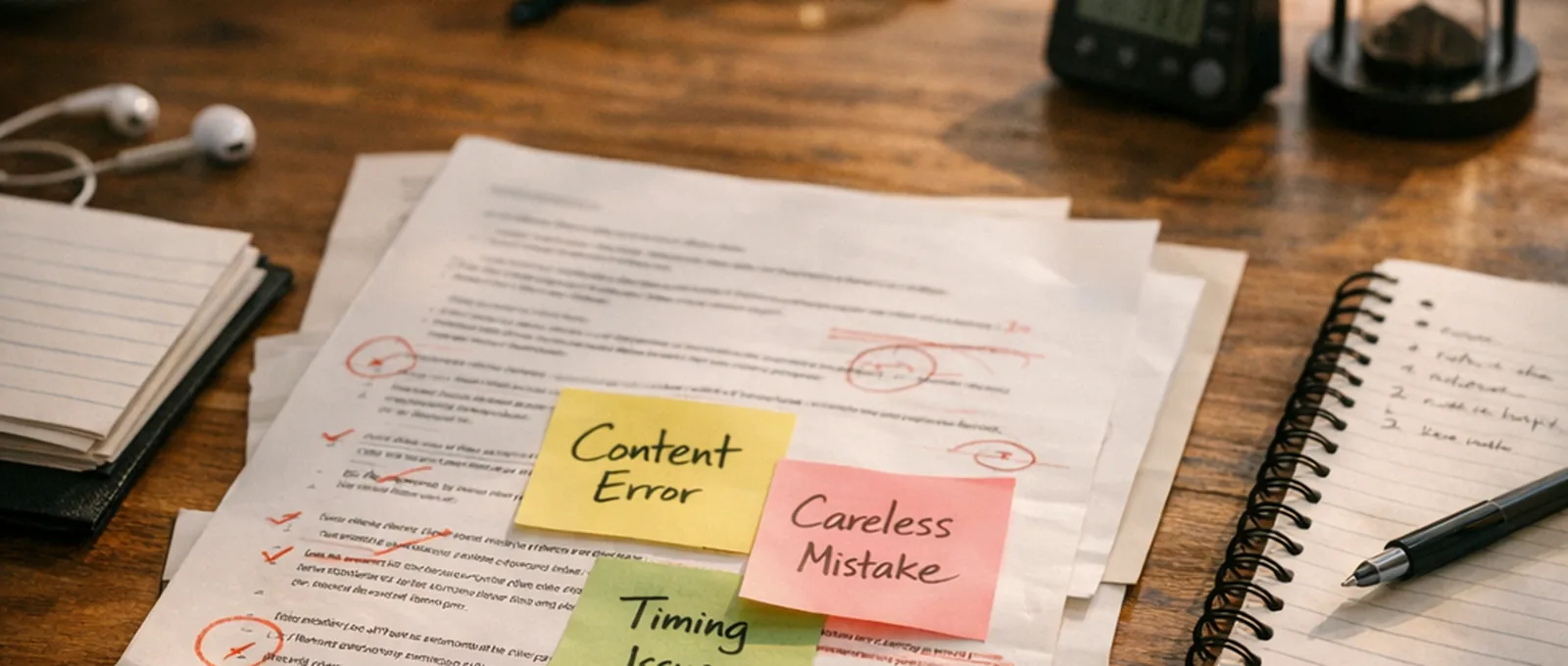
The 25-Minute Exam Wrapper: A Post-Test Review That Turns Mistakes Into Guaranteed Score Gains
You already paid for your mistakes (with points). The exam wrapper makes sure you don’t pay twice.
Set a timer for 25 minutes. No overthinking. Just turn every lost point into a cause and a fix.
What an “exam wrapper” is (and why it works fast)
An exam wrapper is a short, structured post-exam review that converts feedback into next-test improvements.
High ROI, because you’re reviewing your real mistakes—not guessing what might be on the next exam.
Definition: a repeatable post-test checklist that diagnoses why you lost points and what you’ll do differently next time.
Why it works: it kills vague plans like “study more” and replaces them with specific rules + targeted practice.
What it fixes: repeated errors, careless slips, time panic, and endless rereading.
Works for: math/science problem sets, history/English quizzes, MCQ exams, and short-answer tests.
When to do it
Ideal: within 24–48 hours of getting the test back, while your thinking is still fresh.
If you can’t take it home: do it in the hallway/library with quick notes (or photos if allowed).
If you only get a score: use memory + rubric + any item analysis your teacher provides.
The 25-minute exam wrapper (timer-based, no overthinking)
This works because it’s short and repeatable, not because it’s perfect.
Goal: Convert each lost point into (1) a cause and (2) a specific fix.
Minute 0–3: Snapshot the results
Write your score, class average (if available), and the unit/topics.
Circle the 3 biggest-point questions or the ones that surprised you most.
Quick gut-check: “I felt prepared / half-prepared / unprepared.” No shame. Just data.
Minute 3–12: Tag every missed point (use 5 mistake categories)
For each missed question, label the cause. One line each. No personality diagnoses allowed.
Content gap: didn’t know/understand the concept.
Process gap: knew the concept but the steps/method were shaky.
Misread: missed a word/condition/negative or answered the wrong thing.
Time pressure: rushed, left blank, guessed, or ran out of time.
Careless: arithmetic slip, copied wrong, sign/units error, bubbled wrong choice.
Write the cause like this: “Forgot to convert units” or “Didn’t notice ‘EXCEPT’.” Not “I’m bad at tests.”
Minute 12–18: Extract the pattern (the “3 rules” step)
Count your tags. What’s your #1 and #2 mistake category?
Write 3 rules you’ll follow next time. Short. Actionable. Usable during the test.
Examples of rules that actually work:
“Underline what the question asks before solving.”
“Always write units on every line.”
“If stuck for 45 seconds, mark it and move.”
Minute 18–25: Turn mistakes into a fix plan (active recall + spaced repetition)
Now you build the smallest plan that prevents repeats.
Content/process gaps: create 3–10 recall prompts (questions you answer without notes).
Misread/careless: create a 2–5 item pre-submit checklist.
Time pressure: set a pacing rule + a simple triage strategy (easy points first).
Schedule two tiny reviews: 10 minutes in 2 days, 10 minutes in 7 days.
Pick one today action you can do in under 15 minutes so it actually happens.
How to log this in LogMyStudy (simple template you can reuse)
In LogMyStudy, make a study entry called:
Exam Wrapper — [Class] — [Unit/Test Name]
Attach photos/notes of missed questions (if allowed).
Log the time spent (25 minutes). You’ll start seeing what study methods actually move your score.
Fields to capture (copy/paste friendly)
Score + target score for next time
Top 2 mistake categories (from your tags)
Your 3 rules for next test
Fix plan: recall prompts created + review dates (Day 2 + Day 7)
One friction remover: what you’ll change (seat, calculator settings, formula sheet layout, sleep plan, etc.)
Turn missed questions into study tasks (today)
Task type A (Content): “Explain X in 3 sentences + 1 example.”
Task type B (Process): “Redo Q# without notes + check against solution.”
Task type C (Careless/Misread): “2-minute checklist drill before submitting.”
Mark tasks as active recall so you’re testing yourself, not just marinating in your notes.
Printable checklist: the one-page exam wrapper
This is the “no motivation required” version. Same steps every time.
Checklist (copy into notes or print)
[ ] Score + topics + how prepared I felt
[ ] Tag every missed point: Content / Process / Misread / Time / Careless
[ ] Identify top 2 categories
[ ] Write 3 rules for next time
[ ] Create recall prompts for weak topics (3–10)
[ ] Create a 2–5 item checklist for misread/careless
[ ] Pick pacing/triage rule if time was an issue
[ ] Schedule reviews: +2 days, +7 days
[ ] Do 1 quick action today (≤15 minutes)
10 reflection prompts (use the ones that match your situation)
Answer in 2–3 lines each. Patterns, not essays.
If you’re short on time, do #1, #4, #7, and #10.
Prompts
What was the test actually testing (skills + concepts), not just the chapter title?
Where did I feel confident—but was wrong? What fooled me?
Which mistakes were preventable with a 10-second check?
What’s the one concept I need to be able to explain without notes?
What step breaks down most often (setup, algebra, interpretation, wording)?
Did I lose points because I didn’t show work/justify answers the way the teacher wanted?
What would I do first if I could retake this test tomorrow?
What type of question should I practice 5 more times (same format, different numbers/contexts)?
What was my time plan during the test—and what will I change next time?
What is my minimum effective study plan for the next assessment (smallest plan that moves the score)?
Common scenarios (quick fixes that actually help)
You don’t need a new personality. You need one small system tweak per pattern.
If your #1 problem is content gaps
Make recall prompts from the exact wrong questions (not the whole textbook section).
Do a short teach-back: explain it out loud like you’re tutoring.
Practice in mixed order (interleaving) so you learn when to use the concept.
If your #1 problem is careless/misread
Write a 3-item “before submit” checklist and force yourself to use it.
Slow down only on the last 10%: units, signs, and what the question actually asked.
Highlight trap words: NOT, EXCEPT, least/most, at least/at most.
If your #1 problem is time pressure
First pass = quick wins, second pass = medium, last pass = hard.
Use a stuck rule: if no progress in 45–60 seconds, mark and move.
Practice timed sets (even 6 questions / 10 minutes) to build pacing.
Make it stick: a tiny routine that compounds
Do an exam wrapper after every quiz (even small ones). That’s where patterns show up.
Track your top mistake category each time. Over the semester, you want it to change.
After 3 wrappers, create your personal “Top 5 Rules” sheet for that class.
Your goal isn’t “no mistakes”—it’s “new mistakes”
Repeated mistakes = system problem.
New mistakes = you’re leveling up and hitting harder material.
Use LogMyStudy to keep your rules + fix plan in one place so you don’t reset every unit.
FAQ
Do exam wrappers work even if I already review my test?
Yes—most “review” is rereading answers. A wrapper forces you to label the cause (content vs. misread vs. time vs. careless) and create a prevention rule + practice plan. That’s what changes future scores.
What if my teacher doesn’t give the test back?
Do the wrapper using what you can: your memory of tricky questions, the topics list, the rubric, and any item analysis. Focus on patterns (time pressure, misread, careless) and make recall prompts for the topics you felt shaky on.
How many missed questions should I analyze?
All missed points is ideal. If time is tight, analyze the highest-point questions and the ones you were most confident about—those expose the biggest blind spots.
Isn’t this just test corrections?
Test corrections usually stop at “right answer + explanation.” An exam wrapper adds diagnosis (why it happened) and prevention (rules + spaced reviews), so you don’t pay for the same mistake twice.
How do I turn a mistake into an active recall prompt?
Turn the error into a question you can answer without notes. Example: instead of “Review photosynthesis,” write “What are the inputs/outputs of photosynthesis and where do they occur?” Then quiz yourself on Day 2 and Day 7.
What’s the minimum version if I only have 5 minutes?
Tag missed points into the 5 categories, write 1 rule for next time, and schedule one 10-minute recall session within 48 hours. That alone prevents a lot of repeat mistakes.